

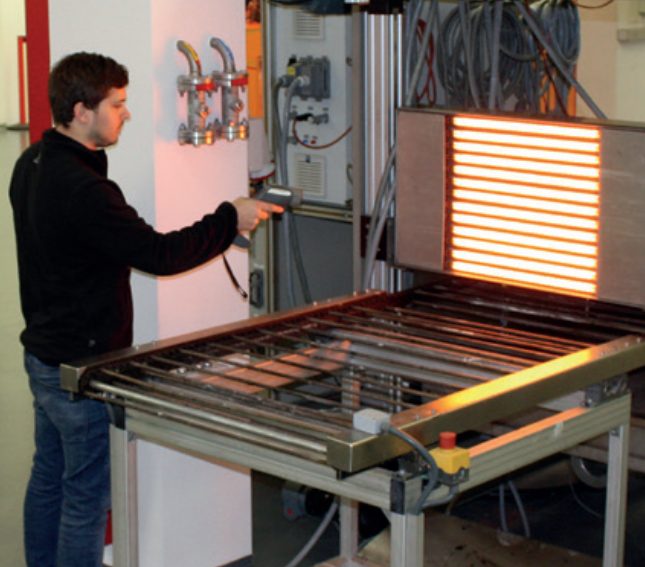
On the fab floor, a 0.5°C drift during photoresist bake is enough to scrap an entire lot. Wafers sit, tools go idle, and the schedule takes a hit. We built our photovoltaic silicon wafer heater to take that variability off the table. Here’s what matters under the hood. The unit leans on short-wave infrared emitters in a quartz-enhanced thermal stack to hit wafer-level uniformity within ±0.1°C across the active area. Temperature settles in seconds, and closed-loop control keeps the thermal budget tight on every soft bake and hard bake. It’s compatible with Cleanroom Class 1–100, thanks to a particle-controlled design that keeps emissions near zero. The heater body and fixtures are built to survive repeated wet-clean cycles without outgassing. Power density is matched to the substrate, and the interface uses standard mechanical and electrical connections so it drops cleanly into existing coat/bake tracks. Lithography lives and dies on repeatable bake profiles. Tight uniformity and fast settling cut linewidth variation, improve adhesion, and reduce rework. You end up with higher first-pass yield and fewer metrology holds. The heater runs 24/7 with predictable maintenance intervals, so unplanned downtime drops. Energy use is trimmed by the rapid response and low thermal mass, which cuts idle power and cool-down losses. Installation comes down to a stable, flat mounting surface and verified cooling to hold the setpoint under sustained duty cycles. The heater performs at specified line voltage and needs to be matched to the controller’s calibration range; mismatched wiring can introduce small offsets. Plan a short commissioning run to lock the recipe and confirm particle performance in your specific environment.